
 01 December, 2025


Every leader knows time has value, but very few quantify it with precision.
The most common mistake in evaluating travel cost is stopping at the fare. The true expense is the time lost to waiting, transfers, and overnight stays that add no business value. When those hours are accounted for, the equation between first-class and private aviation changes completely.
Start with a simple premise. Executive time is among a company’s highest-value resources. Every hour spent waiting in an airport queue or sitting in traffic is an hour that could have produced measurable outcomes. Yet most travel decisions still focus on ticket price rather than total productivity impact.
A practical way to evaluate travel choices is to assign a notional value to an executive’s hour. For example, assume ₹50,000 per hour as a conservative estimate of leadership time. Now compare two travel models: commercial first-class and private charter. The first may appear cheaper on the surface, but once the hours saved are translated into financial terms, the advantage often shifts.
Consider a Mumbai-Hyderabad-Delhi itinerary. On commercial flights, it typically involves early check-ins, long transfers, and one overnight. Door-to-door, that schedule consumes nearly twenty-four hours. The same circuit on a private aircraft can finish comfortably within ten hours. That is a fourteen-hour difference. Even if half those hours are productive and valued at ₹50,000 each, the saved time is worth ₹3.5 lakh before factoring in continuity benefits.
Continuity often delivers the hidden return. A day recovered means one more client meeting, one more deal concluded, or one more internal review completed without delay. Those gains cannot always be measured directly, but their cumulative effect across a quarter or a financial year can easily exceed the fare difference.
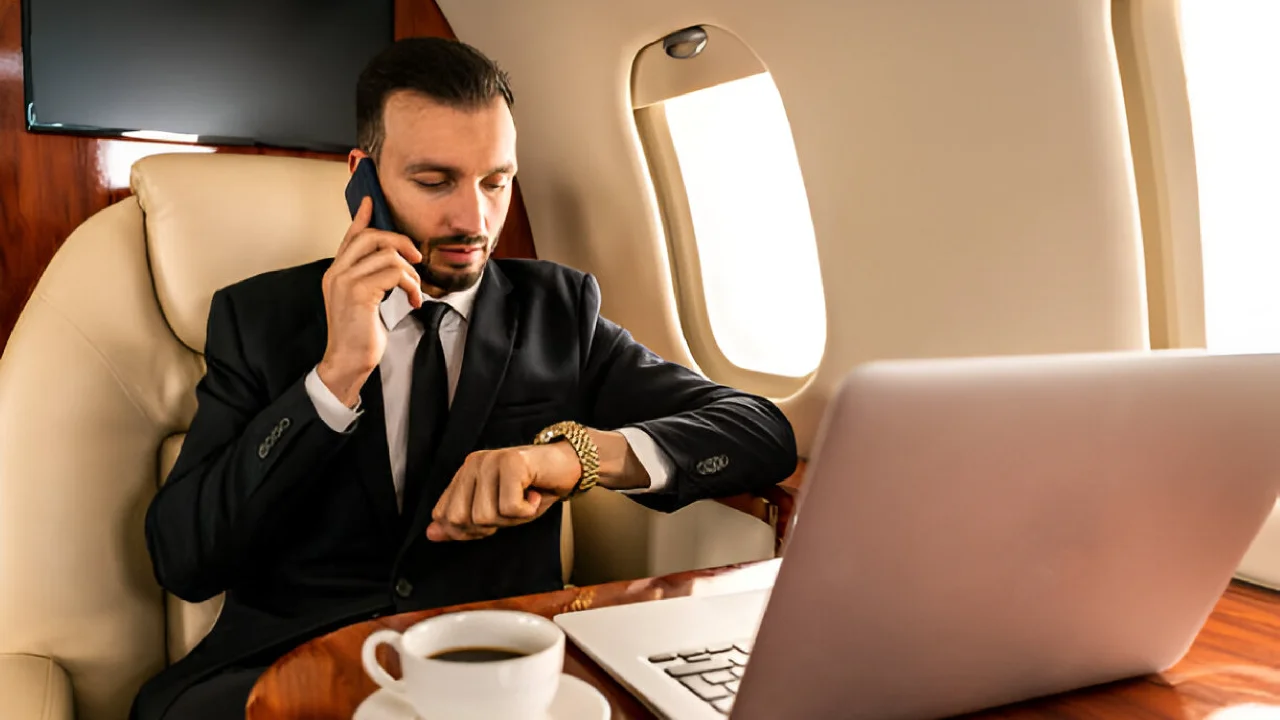
The other dimension is momentum. When executives travel privately, discussions begin on board and continue until arrival. Confidentiality is maintained, and preparation happens in transit rather than after landing. That flow of thought and action keeps leadership aligned and shortens decision cycles. Time saved is valuable, but uninterrupted progress is priceless.
Seen through this lens, private aviation is not a discretionary luxury. It is an operational tool that safeguards productivity at the leadership level. It converts idle travel hours into usable business time. For organizations that depend on high-velocity decision making, that conversion is often the most rational investment they can make.
For leaders evaluating the trade-off, the rule is simple: if the hours saved across a quarter’s travel exceed the fare difference, private aviation pays for itself. The return is not theoretical. It appears in faster outcomes, steadier schedules, and reduced fatigue across the leadership team.
In the next post, we will look at how executives can decide when to choose first-class and when a private charter creates greater business value.
Write to us at info@jetsetgo.in
Call us at +91-11-40845858
Let’s Plan Your Journey
07 February, 2025
Read More >
10 April, 2026
Read More >

07 February, 2025
Read More >
JetSetGo sets the benchmark in private aviation
JetSetGo, a trusted choice for those valuing time, service, and reliability. Explore unique features to customize your private flying experience your way.

 IN +91-11-40845858
 CSR Policy


